
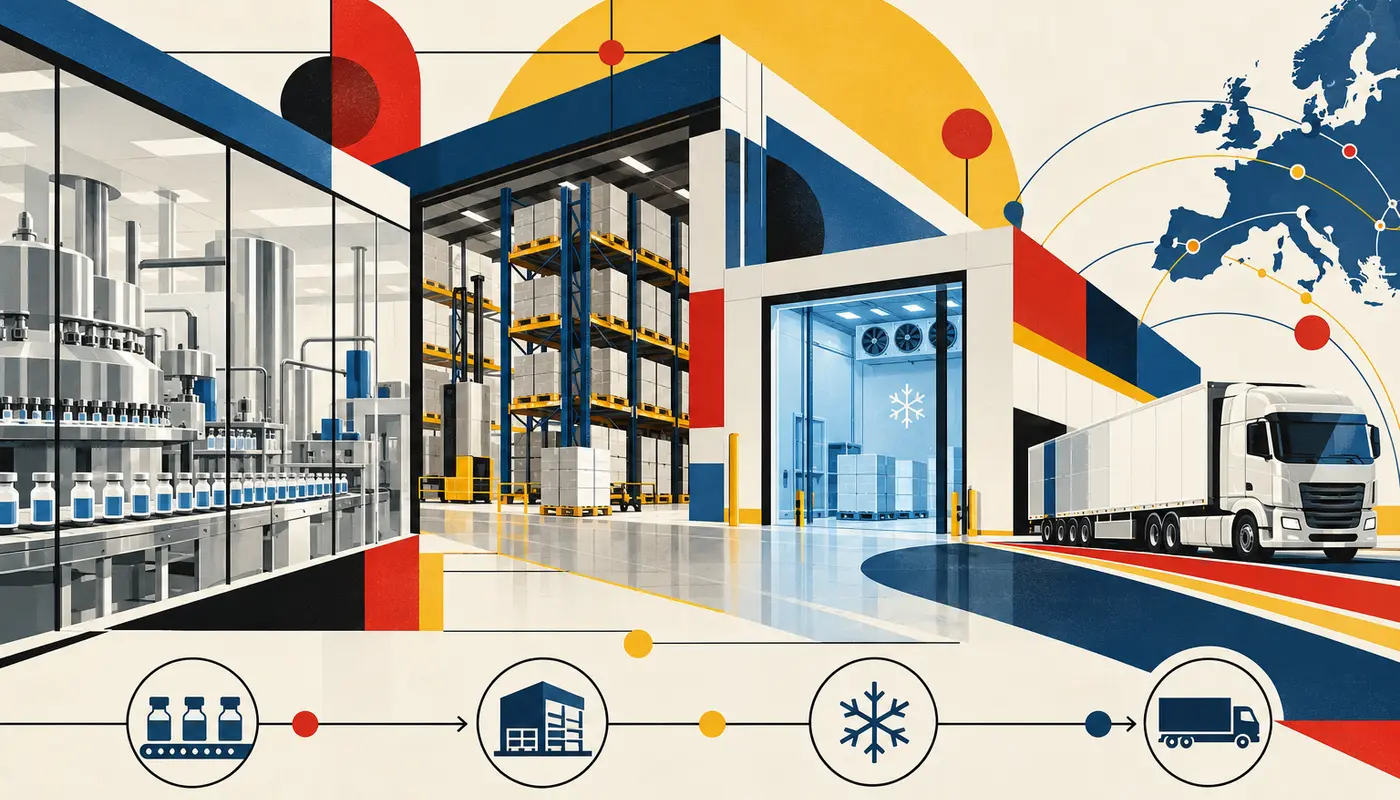
Expanding pharmaceutical research and manufacturing in Europe is an important goal. Reliable access to medicines, however, depends on the entire supply chain – from manufacturer to patient. Industrial policy supporting pharmaceuticals and biotechnology should therefore also address qualified warehouse capacity, pharmaceutical cold chains and cross-border distribution.
What the industrial strategy paper proposes
Published in September 2026, “Fokussierung, Souveränität und neue Wertschöpfung. Eine industrie- und wirtschaftspolitische Strategie für Deutschland” sets out proposals for a more focused German industrial policy. Pharmaceuticals, biotech and medical technology are among its priority sectors. Deepening the European market, resilience and strategic sovereignty are further themes.
For tiger.PHARMA, these priorities make it essential to consider the medicines supply chain as a whole. The pharmaceutical logistics proposals below are our professional and economic interpretation, rather than demands quoted from the paper's authors.
GDP-compliant warehousing: availability needs qualified capacity
Pharmaceutical warehousing that meets Good Distribution Practice requirements, together with appropriately sized safety stock, can help bridge supply disruptions. Spare pallet positions alone are insufficient. Stock must be available, its quality protected and its storage conditions controlled. Demand, stock coverage, expiry risk and working capital need to be planned together.
Strategic inventory should be defined for each product and reviewed regularly. Additional stock without a turnover plan can increase costs and wastage. GDP warehouse qualification provides a basis for assessing storage areas, temperature monitoring and documented procedures.
Pharmaceutical cold chains: protect quality at every handover
Temperature-sensitive medicines require controlled conditions during storage and transport. Product-specific requirements must be maintained throughout the distribution lane. A robust approach combines suitable packaging, qualified processes, traceable temperature records and clear decisions when excursions occur.
The EU Guidelines on Good Distribution Practice of medicinal products for human use (2013/C 343/01) provide the professional framework for storage and distribution. Practical support with temperature control in pharmaceutical logistics connects product requirements, transport lanes and quality assurance.
European distribution: build supply networks across borders
Europe needs effective cross-border distribution networks. Our logistics partner InterPharma CEE can serve both the German and Czech markets from Cheb. Its pharmaceutical expertise supports an understanding of the requirements of both markets.
Cross-border operations need clearly defined handovers, responsibilities, inventory information and escalation routes. Together, these elements turn additional manufacturing capacity into medicines that can reach patients. InterPharma CEE provides information about the location and its pharmaceutical warehousing services.
Our proposal: assess and pay for supply resilience
Procurement decisions should explicitly recognise supply resilience. Genuinely independent supply sources, qualified stockholding and logistics contingency capacity have economic value. Where additional resilience is required, tenders and contracts need to account for its cost.
The lowest purchase price alone does not capture that value. Useful assessment criteria include committed availability, robust delivery lanes, stock coverage, temperature control and agreed contingency procedures. Safety stock can cushion disruptions, but it cannot replace an investigation into their causes.
tiger.PHARMA supports GDP pharmaceutical logistics and warehousing, from process planning to the integration of storage, transport and quality management. Which capacities does your supply chain need to make resilience operationally effective and commercially sustainable?
Download the original strategy paper
The full strategy paper is available as an unchanged, 29-page German-language PDF. The download filename has been clarified to make its subject easier to identify.
Download the industrial strategy paper (German PDF, 29 pages)
Authors of the strategy paper: Christian Agethen, Carolin Albrecht, Frederik Digulla, Sebastian Dullien, Thomas Losse-Müller, Jens Südekum and Jakob von Weizsäcker. Linked names lead to their verified LinkedIn profiles.
Source: Fokussierung, Souveränität und neue Wertschöpfung, September 2026. The analysis and pharmaceutical logistics proposals are tiger.PHARMA's contribution.